
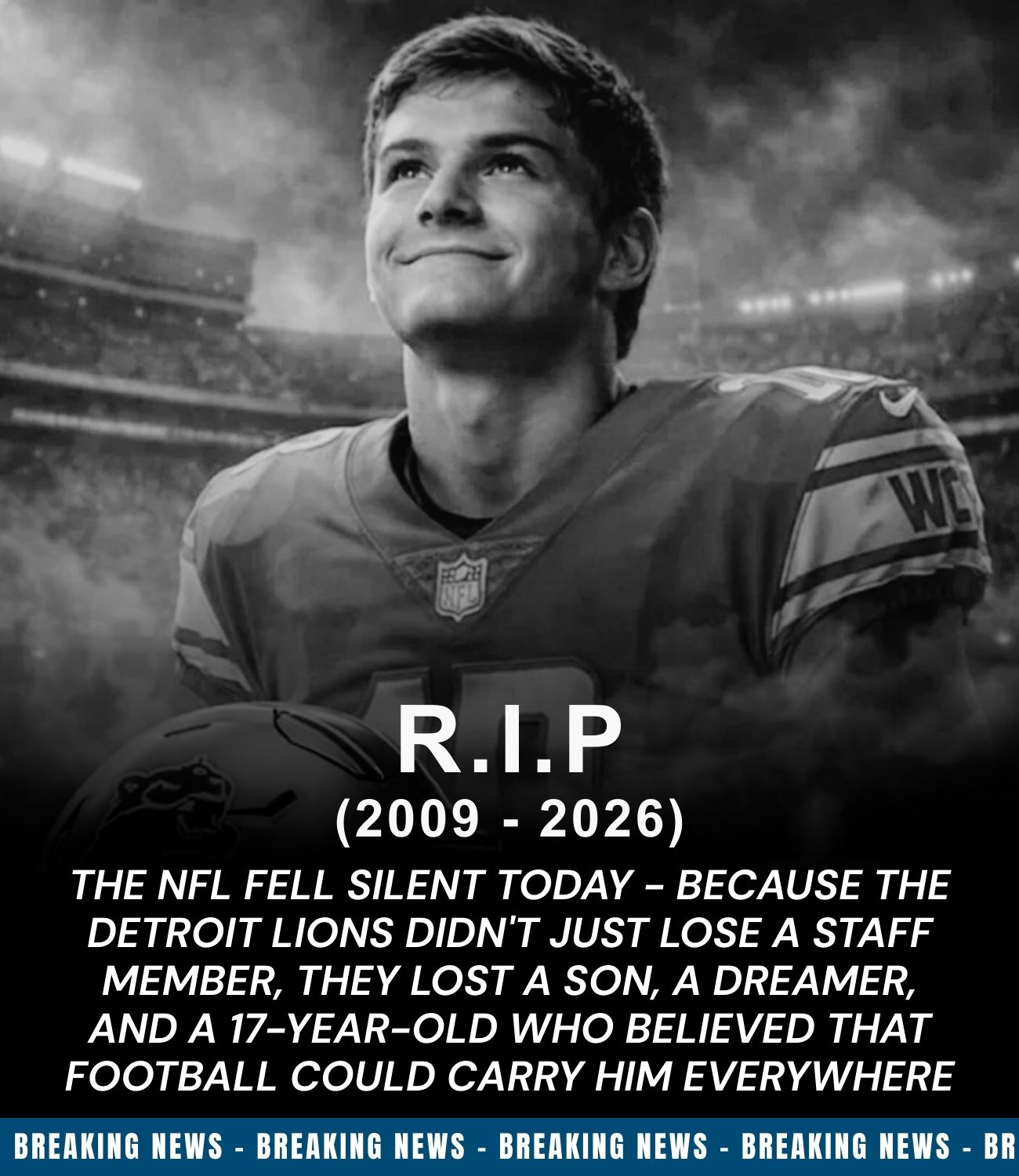
The Detroit Lions community is reeling from heartbreaking news that has left fans, coaches, and young athletes across the country stunned into silence and struggling to process a loss that feels both personal and profoundly unfair.
Kyler Dailey, a highly promising high school athlete once viewed as a shining symbol of the future, has passed away suddenly, sending shockwaves far beyond Detroit and igniting waves of grief, disbelief, and urgent reflection.
He was not yet a professional star, not yet an MVP, not yet a Player of the Year, but to many who followed his journey, he represented something just as powerful—hope.

In locker rooms, on practice fields, and across social media platforms, Kyler's name had become synonymous with ambition, discipline, and the kind of raw, electrifying talent that fuels championship dreams.
Now, instead of highlight reels and recruiting updates, timelines are flooded with tributes, candlelight photos, and emotional messages from fans who never met him but felt connected to his rising story.
The Detroit Lions organization, known for its tight-knit culture and passionate fan base, has responded with visible heartbreak, and head coach Dan Campbell did not hide his sorrow.
In a brief but deeply emotional statement, Campbell expressed that this loss struck at the heart of what football represents—a brotherhood built on belief, mentorship, and the shared pursuit of greatness.
His words were not polished for spectacle or public relations, but carried the weight of a man who understands how fragile even the strongest dreams can be.
For a franchise that prides itself on resilience and grit, this tragedy feels like a cruel reminder that no amount of preparation can shield a community from sudden loss.
Kyler Dailey was more than a name on a scouting report or a viral clip breaking down defensive backs with unnatural ease and composure beyond his years.
He was a young man whose coaches described him as relentless in practice, humble in victory, and determined to outwork every expectation placed upon his broad shoulders.
Friends recall that he spoke openly about chasing milestones like MVP or Player of the Year not as fantasies, but as goals mapped out through sacrifice and discipline.
That kind of confidence did not come from arrogance, but from the quiet certainty of someone who believed effort could bend destiny.
His passing has sparked a tidal wave of conversation, not only about his promise, but about the immense pressure placed upon teenage athletes in an era of nonstop exposure.
How young is too young to carry the hopes of an entire fan base eager for the next generational talent to lift them toward long-awaited glory?
In the age of recruiting rankings, endorsement speculation, and viral training montages, high school athletes are no longer just students chasing a game—they are brands in the making.
Kyler's rise reflected that reality, as analysts and fans alike projected professional futures onto a teenager still navigating homework assignments and adolescent milestones.
Now, grief is mingling with uncomfortable introspection as communities question whether the culture surrounding youth sports demands too much, too soon, from its brightest prospects.
The Detroit Lions faithful are known for loyalty that borders on spiritual devotion, yet even they are confronting a sorrow that transcends wins, losses, and playoff hopes.
Social media has transformed into a living memorial, with former players, rival fans, and everyday supporters sharing memories, clips, and heartfelt words that echo the same disbelief.

Many posts speak of a smile that lit up practice fields and a leadership presence that made older teammates feel accountable to someone younger yet fiercely committed.
Others highlight the symbolic nature of his journey, seeing in him a reflection of Detroit itself—hungry, determined, and eager to prove doubters wrong.
Head coach Dan Campbell's reaction resonated because it pierced through the usual boundaries between professional franchises and amateur athletes.
He spoke as a mentor, not merely a coach, emphasizing that football families stretch far beyond official rosters and contracts.
That sentiment has fueled an outpouring of solidarity, with youth programs and schools organizing moments of silence and community gatherings in Kyler's honor.
Yet beneath the unity lies a storm of questions that refuse to fade quietly into the background.
What responsibilities do organizations, schools, and media platforms hold when elevating teenagers into near-mythical status before they have even crossed graduation stages?
How do we balance celebration of talent with protection of young minds and bodies navigating pressures older athletes often struggle to manage?
These questions are not accusations, but they are urgent, and they demand honest conversation rather than comfortable platitudes.
Kyler Dailey's story has become a lightning rod because it forces a reckoning with how modern sports culture amplifies dreams while sometimes overlooking the vulnerability behind them.

The tragedy has also reignited debates about athlete wellness, support systems, and the invisible burdens that accompany rapid ascension in competitive environments.
Parents of aspiring athletes are speaking up online, sharing fears about expectations that escalate faster than emotional maturity can reasonably follow.
Former players have added their voices, reflecting on how easily the line blurs between healthy ambition and overwhelming pressure in pursuit of greatness.
Amid these discussions, one truth remains clear: Kyler was deeply loved, and that love has become the foundation for collective mourning and reflection.
In Detroit, murals and makeshift memorials are emerging as symbols of both grief and gratitude for the inspiration he provided during his short but impactful journey.
Young athletes who once studied his moves are now dedicating games and workouts to his memory, vowing to honor the discipline he embodied.
Fans who never saw him play in person feel a surprising intimacy with his story, a testament to how digital storytelling can forge emotional bonds across distances.
The intensity of the response reveals something powerful about sports communities—they do not simply cheer for performance, they invest emotionally in potential.
Kyler Dailey represented potential in its purest form, a future chapter that felt certain to be written in bold letters across stadium scoreboards.
That unwritten chapter is what makes this loss especially devastating, because it leaves imaginations grappling with what might have been.
The phrase "gone too soon" often appears in moments like this, yet it feels painfully literal when describing someone whose prime had not even begun.
Dan Campbell's visible grief underscores that leadership in sports is not confined to tactical decisions or motivational speeches before kickoff.
It also involves guiding communities through sorrow, reminding them that humanity outweighs competition when tragedy strikes.
As tributes continue to pour in, many are calling for more than remembrance—they are calling for change.
They urge schools and organizations to strengthen mental health resources, to foster environments where young athletes can speak openly about stress without fear of appearing weak.
They advocate for a cultural shift that celebrates growth and joy in sports as much as accolades and projections of professional stardom.
Whether those calls will translate into tangible reform remains uncertain, but the conversation has undeniably ignited.
Kyler Dailey's name is now etched into a narrative larger than football, one that challenges how society nurtures and protects its most promising youth.
The Detroit Lions community stands united in grief, yet divided in the debates unfolding about responsibility, expectation, and the true cost of ambition.
Some insist that dreaming big should never be dimmed by fear, arguing that high standards build resilience and opportunity.
Others counter that unchecked hype can suffocate young spirits beneath the weight of adult fantasies and commercial interests.
This tension is uncomfortable, but perhaps discomfort is necessary if progress is to follow heartbreak.
For now, candles continue to flicker outside stadium gates, and jerseys bearing his number are worn with pride rather than anticipation.
In living rooms and locker rooms alike, conversations linger longer, voices soften, and perspectives shift in the wake of a loss that feels both intimate and communal.
Kyler Dailey may never have stepped onto an NFL field, but his impact has already transcended stat sheets and scouting reports.
He has become a symbol of both aspiration and fragility, a reminder that behind every rising star is a human being navigating pressures unseen.
As the Detroit Lions community mourns, it also faces a defining choice about what kind of culture it wants to build for the next generation.
Will this tragedy fade into memory once the season resumes and headlines shift, or will it spark lasting change in how young talent is supported and celebrated?
The answer will shape not only the legacy of Kyler Dailey, but the emotional architecture of communities that dare to dream through their youth.
In the silence left by his passing, one message echoes louder than any stadium roar: potential is precious, and protecting it must matter as much as applauding it.